
Integration middleware and host-solver adapters
AIRgVOF
Non-intrusive middleware and host-solver adapters for coupling the Fortran-based gVOF library with external CFD solvers.
Overview
AIRgVOF is a middleware architecture for connecting gVOF’s Fortran numerical kernels with external multiphase-flow solvers. The current implementation couples a development version of gVOF with OpenFOAM v2606 while keeping the geometric volume-of-fluid algorithms independent of the host solver.
The project explores a non-intrusive integration strategy: OpenFOAM provides the flow solution and MPI domain decomposition, while gVOF provides interface initialization, reconstruction and geometric advection with native OpenMP parallelism. The current results demonstrate the viability of this hybrid architecture.
Current capabilities
- Exchange of mesh, phase-fraction and flux data between OpenFOAM and gVOF.
- Volume-fraction initialization through a hiVOF-based routine in the development version of gVOF.
- Geometric PLIC reconstruction and unsplit interface advection on arbitrary polyhedral meshes.
- Hybrid execution combining OpenFOAM’s MPI parallelism with gVOF’s OpenMP parallelism.
- Consistent, conservative liquid-flux treatment across decomposed-domain boundaries.
Software characteristics
- Host solver
- OpenFOAM v2606
- Languages
- C++ host adapter and Fortran kernels
- Parallel model
- MPI × OpenMP
- Platform tested
- Linux
- Compiler family
- GNU toolchain
- Build
- gfortran, wclean and wmake
Development dependencies: unpublished development versions of gVOF, VOFTools, isoap and hiVOF. macOS support is being investigated but is not currently claimed.
Preliminary result
Three-dimensional rising bubble on a polyhedral mesh
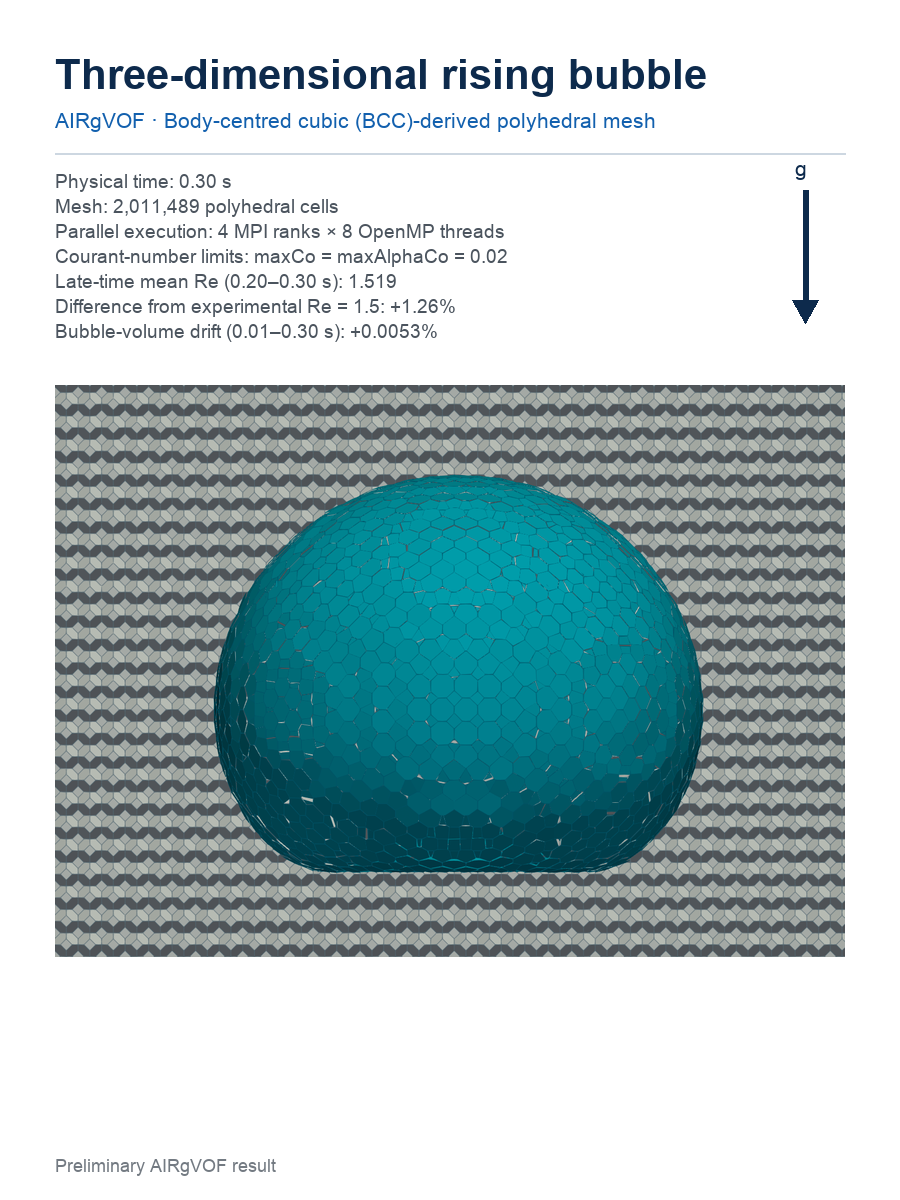
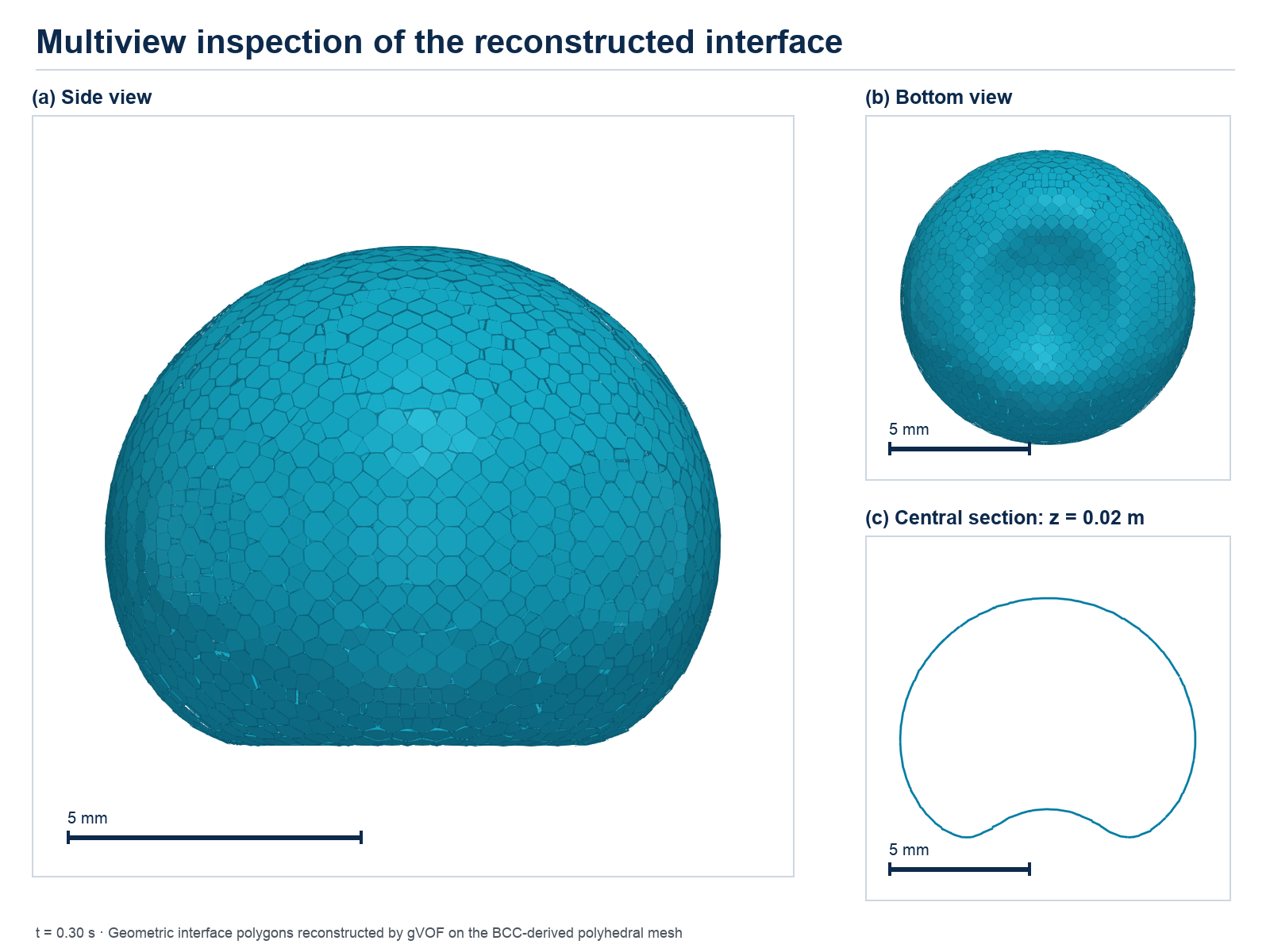
This simulation provides a compact demonstration of the complete integration path on a demanding three-dimensional two-phase problem. A bubble with initial diameter D0 = 10 mm rises in a 0.04 × 0.04 × 0.08 m³ domain discretized by a BCC-derived polyhedral mesh.
| Domain | 0.04 × 0.04 × 0.08 m³ |
|---|---|
| Initial bubble diameter | 10 mm |
| Mesh | 2,011,489 BCC-derived polyhedral cells |
| Nominal BCC resolution | 20 spacings per initial diameter; hBCC = 0.5 mm |
| Volume-equivalent resolution | heq = 0.3992 mm; D0/heq ≈ 25 |
| Parallel configuration | 4 MPI ranks × 8 OpenMP threads |
| Time integration | 8,151 steps to 0.30 s; maxCo = maxAlphaCo = 0.02 |
| Boundedness | Volume fraction remained in [0, 1] |
| Volume conservation | +0.005318% drift from 0.01 to 0.30 s |
| Late-time Reynolds number | Mean Re = 1.519 from 0.20 to 0.30 s; experiment: 1.5 |
Quantitative context
The late-time mean Reynolds number is within 1.26% of the available experimental value of 1.5. Published numerical values for related formulations include 1.70 for PLIC, 1.43 for SCIR and 1.57 for iPPIC. These values provide literature context only: they are not presented as a controlled head-to-head comparison because meshes, implementations and numerical settings differ.
The reference discussion is available in J. López (2026), Unsplit geometric volume-of-fluid method with iterative piecewise-paraboloid interface reconstruction on arbitrary three-dimensional grids, Journal of Computational Physics, 553, 114714. https://doi.org/10.1016/j.jcp.2026.114714.
Development status
AIRgVOF is in active development. Its source code has not yet been released; a public source release is planned after the integration and accompanying scientific documentation are complete.
For research or software enquiries, contact Joaquín López at the Universidad Politécnica de Cartagena.